
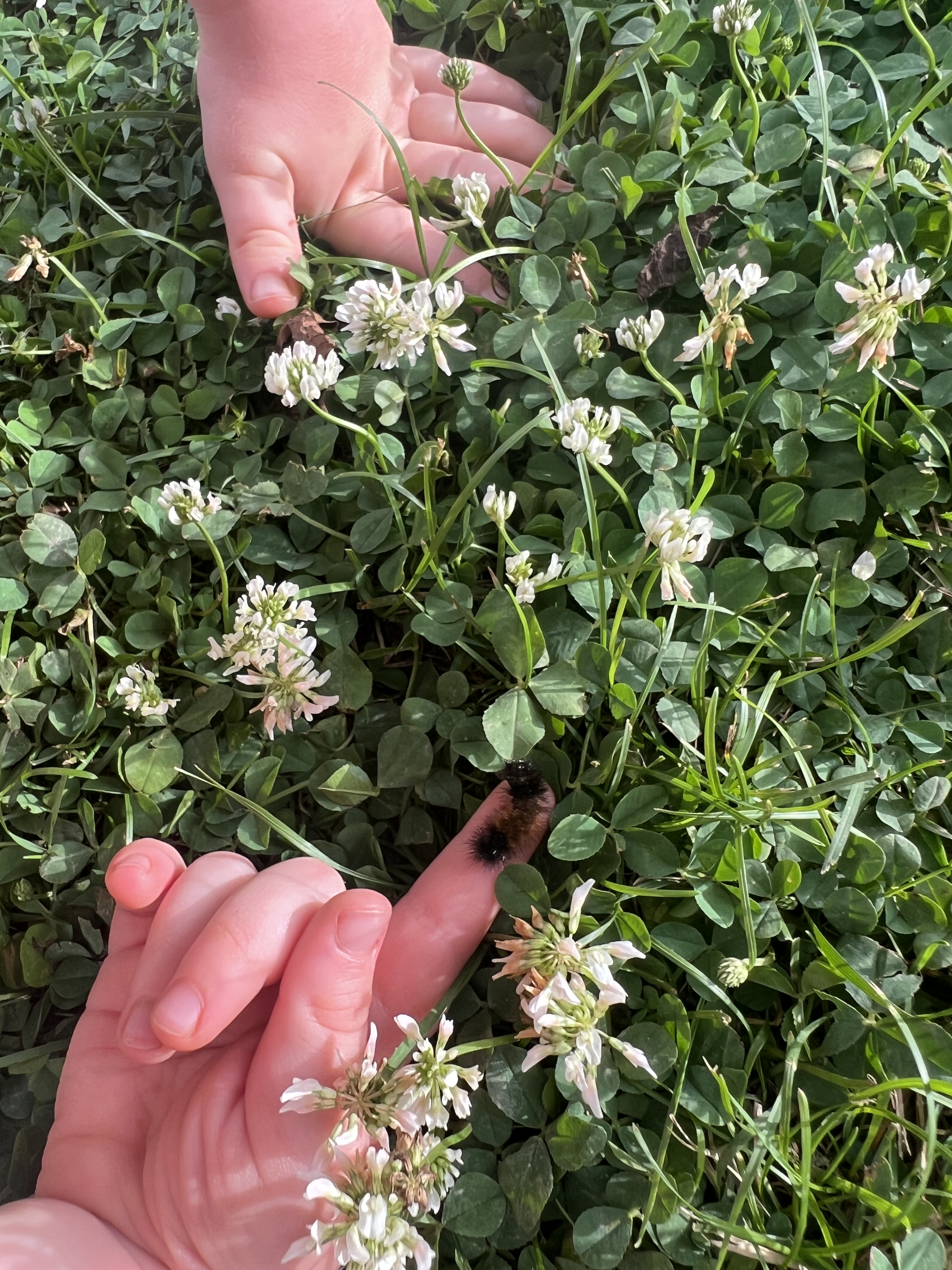
Children can invite us back into attention because their curiosity often interrupts our adult habit of moving toward the next task. When we slow down long enough to join them, we may notice more of the life already happening around us.
A few weeks ago, my son spent nearly fifteen minutes watching ants carry pieces of his peanut butter and jelly sandwich across our stone wall.
He crouched beside the wall, completely absorbed as the ants dragged tiny pieces of bread into the cracks between the stones. He talked to them, cheered them on, and announced every small victory as though he were watching a championship game.
“That one got it in!”
“Look, Mama! That one’s carrying a big piece!”
To him, nothing else seemed more important than watching those ants make their way home.
Meanwhile, my mind was somewhere else. I was thinking about what needed to happen next, what else we had to get done that day, whether I had remembered to add almond milk to the grocery list, and the message I still needed to send back.
Then, somewhere in the middle of all those thoughts, I noticed the contrast.
My son was fully inside the moment. I was already moving toward the next one.
That may be because children often move through the world with a kind of calm, wisdom, and openness that adults sometimes lose over time. They have big feelings, impatience, fears, and frustrations of their own. But they often meet the world with a kind of absorption that can remind us how quickly we’ve learned to move past what’s right in front of us.
Why children can seem more present than adults
Young children are often less burdened by the mental work that fills so much of adult life. They aren’t usually managing calendars, anticipating next week’s responsibilities, replaying a difficult conversation, or trying to keep a household, job, relationship, and dozens of small obligations moving at once.
That doesn’t mean their lives are uncomplicated. It simply means their attention is often more available for what’s directly in front of them.
A child can spend twenty minutes building a tiny world out of leaves and stones. They can become completely absorbed in watching water move through a storm drain or studying a bug on the sidewalk. What captures their interest may not seem important to us, but their willingness to be interested is.
As adults, we often filter experience through efficiency, productivity, and outcomes. We’re used to asking what something will lead to, how long it will take, or whether it’s worth the interruption. Sometimes those questions are necessary. They help us manage real responsibilities and care for the people who depend on us.
But efficiency can become such a constant way of moving through the world that we begin to overlook anything that doesn’t seem immediately useful. Learning to notice life more fully is part of what it means to live consciously. It asks us to remain open to the possibility that something small may still be worth seeing.
The pace of childhood
One of the challenges of parenting is that children often move at a different speed than adults.
They stop to examine rocks, ask questions we’re in no hurry to answer, and become deeply engaged with things that may seem insignificant from the outside. They linger where we would keep moving and wander where we would stay focused on the destination.
I’ve lost count of how many walks have taken twice as long as I expected because my son found something interesting along the way. A storm drain. A flower. A puddle. A stick that somehow deserved a detailed inspection.
My instinct is often to keep moving, while his is to stay and explore a little longer. Neither approach is inherently right or wrong. Adults have places to be, work to finish, meals to make, calls to take, and responsibilities that can’t always be postponed.
But when I allow myself to enter his world for even a few minutes, I’m often reminded of how rarely I give my full attention to anything. Not because I don’t want to, but because I’ve become accustomed to rushing.
This is one of the ways we can miss the life we’re living while we’re busy trying to keep it moving. The point is not to abandon the responsibilities of adulthood. It’s to notice when efficiency has become the only way we know how to move through a day.
Presence isn’t a permanent state
For years, I assumed presence was something I would eventually achieve.
I thought that if I meditated enough, read enough, learned enough, and spent enough time working on myself, I would one day become calmer, more aware, and less likely to disappear into my thoughts.
That hasn’t been my experience.
Presence is less a state to maintain than a way of noticing where our attention has gone. Sometimes I realize I’ve drifted into planning or replaying something else entirely.
When he says, “Mama, look,” he isn’t asking me to become a perfectly attentive parent. He’s simply inviting me into the moment he’s already having.
I can’t accept every invitation. No one can. There are times when I need to finish the email, make dinner, take the call, or say, “Give me one minute.” But I have begun to notice how often those small invitations offer a chance to step out of the mental noise and into the life happening in front of me.
That’s part of why presence is so difficult. Attention drifts for many understandable reasons: responsibility, worry, exhaustion, planning, distraction, and the constant pull of what seems to need us next. Drifting doesn’t mean we’re failing at mindfulness or failing the people we love.
What children notice that adults miss
Children often notice what adults have learned to treat as background.
They see the shape of a cloud, the way sunlight catches in a puddle, the texture of a leaf, the strange movement of an insect, or the tiny changes in a familiar walk. They may ask the same question several times because the question still feels alive to them.
Wonder doesn’t always begin with something extraordinary. Often, it begins with a willingness to be interested.
As adults, familiarity can make us less available to the details of our own lives. Another tree. Another flower. Another walk around the block. Another evening at home. We may assume we’ve already seen what’s there, even when no moment is exactly the same as the one before it.
Much of how we find meaning in everyday life has to do with this kind of attention. Meaning isn’t always hidden in major milestones or dramatic experiences. Sometimes it gathers quietly in the details we would have walked past if we hadn’t paused long enough to see them.
Children don’t make every ordinary moment meaningful. Neither do adults. But their curiosity can remind us that the world is often more detailed than we’ve given it credit for.
Presence as a form of love
One of the most unexpected things I’ve learned through motherhood is that presence is also a relationship practice.
People can feel when we’re truly with them. They can feel the difference between being listened to and being managed, between being glanced at and being seen. This is especially true with children, who often ask for our attention in ways that seem small but aren’t small to them.
When a child says, ‘Look,’ they’re rarely asking for a lesson or an explanation. They’re inviting us into something that has become extraordinary to them because they’ve stopped long enough to notice it.
Learning how to be more present in everyday life often begins in these ordinary relational moments. It doesn’t require perfect attention or endless availability. It asks for a willingness, when we can, to pause the mental checklist and join someone in the moment that matters to them.
Presence can say something words often cannot: I’m here. I see what you’re showing me. I’m willing to let this matter for a little while.
What children can remind us
Children aren’t a model adults need to imitate perfectly. We’re not meant to return to childhood, abandon planning, or pretend that adult responsibility doesn’t exist.
But children can remind us that attention isn’t only for what’s urgent, productive, or impressive. Sometimes it belongs to the ant carrying a crumb, the puddle after a rainstorm, the question asked for the fifth time, or the walk that takes longer than expected.
These moments rarely arrive as revelations. More often, they arrive in the middle of an ordinary day, disguised as interruptions we may be tempted to rush past.
A child doesn’t have to teach us anything for us to learn from the way they meet the world. Sometimes their curiosity simply gives us a reason to look again.
Continue reading
If this reflection made you want to stay a little closer to the life in front of you, these pieces offer a few more places to continue.
- How to Be More Present in Everyday Life
- Why Presence Is So Difficult
- Why We Miss the Life We’re Living
- How to Find Meaning in Everyday Life
If You’re Wondering…
Why do children seem more present than adults?
Children can appear more present because their attention is often less divided by planning, responsibility, work, technology, and the mental load adults carry. They may also be more willing to stay with something simply because it interests them.
Can children really teach adults mindfulness?
Not in a formal sense. But a child’s curiosity and immersion in what is directly in front of them can remind adults to slow down, look again, and notice what they may have otherwise rushed past.
Why is it hard for adults to slow down?
Adults often have real responsibilities that require planning, efficiency, and attention to what comes next. Slowing down can feel difficult when work, caregiving, financial pressure, mental load, and digital distraction are all competing for attention.
What can parents learn from their children about attention?
Children can remind parents that attention doesn’t always need to be earned through usefulness or achievement. Their curiosity can invite us to notice small details, listen more fully, and make room for moments that matter to them.
How can I be more present with my child without trying to be perfect?
Start by noticing one invitation you can accept. Look at what they are showing you, listen through the end of their story, or pause beside them for a few extra seconds. You won’t be available for every moment, and you do not need to be. Presence grows through small acts of attention, not perfection.
A gentle reflection
Maybe we don’t need to become children again in order to live with more presence.
Adult life will always ask something of us. There will be schedules to keep, work to complete, people to care for, calls to return, and times when moving quickly is necessary. There’s no virtue in pretending otherwise.
But sometimes, when someone we love asks us to look, we can let ourselves pause.
We can notice the ant. We can watch a child discover something we might have missed. We can remember that the world doesn’t become less alive simply because we’ve grown used to moving through it quickly.
Presence may begin there: not by becoming someone different, but by allowing ourselves to see a little more of the life already in front of us.
Leave a Reply