
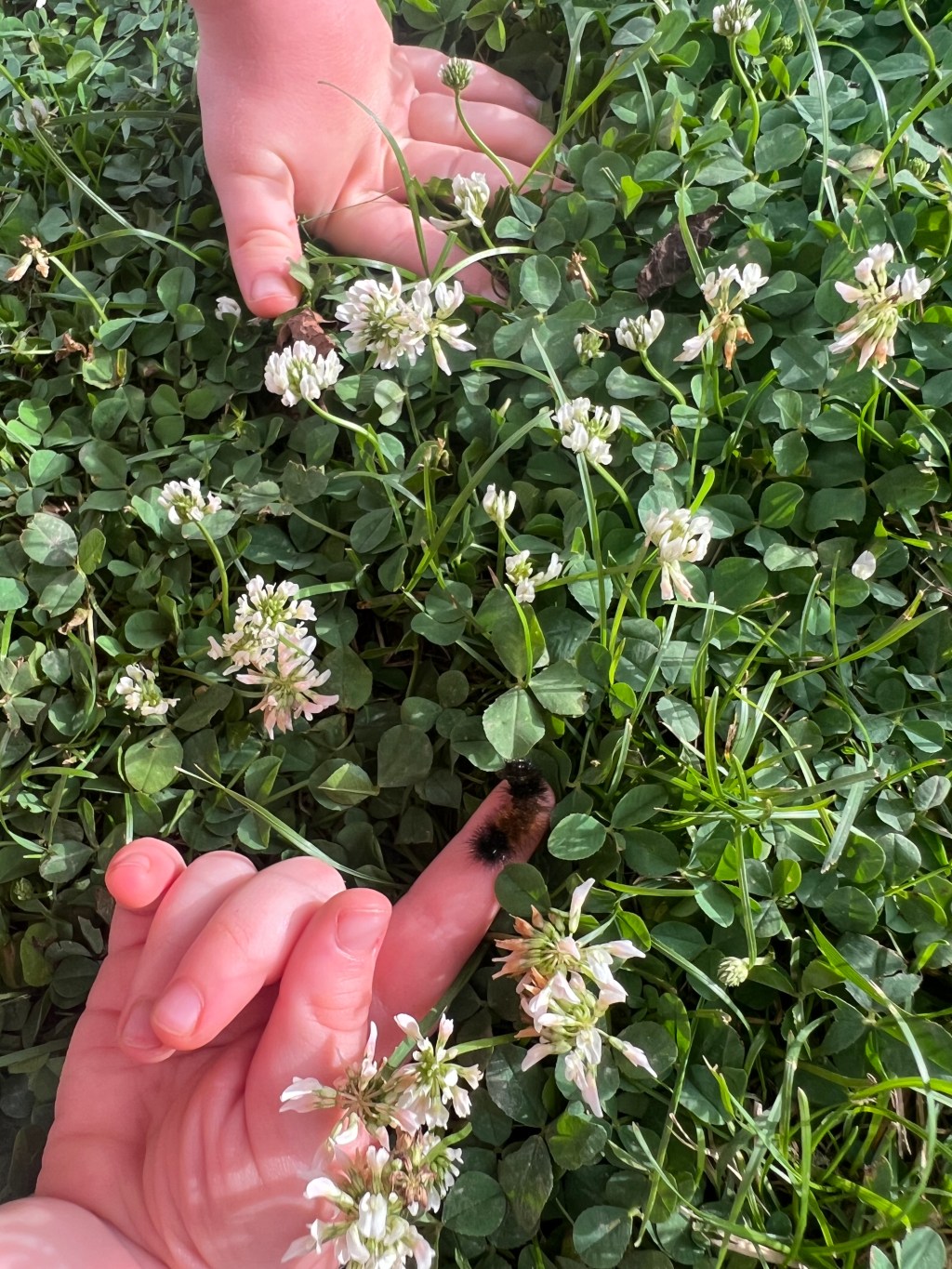
Children have a remarkable ability to inhabit the moment they’re in. By slowing down long enough to join them, we often discover a different way of experiencing our own lives.
A few weeks ago, my son spent nearly fifteen minutes watching ants carry pieces of his peanut butter and jelly sandwich across our stone wall.
Fifteen minutes.
Not because someone had asked him to. Not because it was educational. Not because he was trying to practice mindfulness.
He was simply fascinated.
The ants were carrying tiny bits of sandwich into the cracks between the stones, and he was completely absorbed in their work. He crouched beside the wall, giggling, talking to them, and cheering them on as they navigated their oversized treasures toward home. Every successful delivery was cause for celebration.
“That one got it in!”
“Look, Mama! That one’s carrying a big piece!”
Again and again, he excitedly announced each tiny victory as if he were watching a championship game.
Meanwhile, I found myself doing what many adults do. I was thinking about what came next.
How much longer would this take? What else needed to get done that day? Did I put almond milk on the grocery list? I think I forgot to text my friend back. . .
Then, somewhere in the middle of those thoughts, I noticed the contrast.
My son wasn’t trying to get anywhere else. I was.
The ants became irrelevant.
The moment became the lesson.
Not because my son was trying to teach me something, but because children have a way of revealing how differently they experience the world.
Why Children Seem More Present Than Adults
One of the reasons children often appear so present is that they’re not carrying the same mental weight most adults carry.
Young children aren’t usually planning next week’s schedule. They’re not replaying yesterday’s conversation or worrying about next month’s obligations. Their attention tends to remain anchored to whatever is directly in front of them.
That doesn’t mean they’re enlightened.
It means they’re children.
Yet there is something worth noticing about the freedom with which they give their attention.
A child can spend twenty minutes building a tiny world out of leaves and stones. They can become completely absorbed in watching ants carry crumbs across the ground. They can ask questions about things most adults walk past without a second glance.
What captures their interest isn’t always important. But their willingness to be interested is.
Children don’t spend much time deciding whether a moment is worthy of their attention.
They simply give it.
As adults, we’ve become accustomed to filtering experience through efficiency, productivity, and outcomes. We’re often evaluating what something will lead to rather than fully experiencing what it is. We also tend to assume we’ve already seen what’s in front of us. Another tree. Another flower. Another ant carrying a crumb across the sidewalk. Familiarity can make us overlook the subtle differences, details, and beauty that are present in ordinary things.
Learning to notice life more fully is one of the reasons I’ve become interested in what it means to live consciously. Not because I believe every moment needs to be profound, but because so much of life passes by when we’re distracted, rushing, or convinced we’ve already seen what’s worth seeing.
Children haven’t yet learned to dismiss the world so quickly. They remind us that life isn’t always asking to be evaluated or categorized. Sometimes it’s asking to be noticed. And often, the moments we notice become the moments that carry the most meaning.
The Pace of Childhood
One of the greatest challenges of parenting is that children move at a different speed than adults.
They stop to examine rocks, ask questions we’re in no hurry to answer, and become completely absorbed in things that seem insignificant from the outside. They linger where we would keep moving and wander where we would stay focused on the destination.
When we’re busy, this difference can feel frustrating. When we’re paying attention, it can be surprisingly revealing.
I’ve lost count of how many walks have taken twice as long as I expected because my son found something interesting along the way. A storm drain. A flower. A puddle. A stick that somehow deserved detailed inspection.
My instinct is often to keep moving, while his is often to stay and explore a little longer. Neither approach is inherently right or wrong, but when I allow myself to slow down and enter his world for a few moments, I’m often reminded of how rarely I give my full attention to anything.
Not because I don’t want to, but because I’ve become accustomed to rushing.
My instinct is often to keep moving, while his is often to stay and explore a little longer. Neither approach is inherently right or wrong, but when I allow myself to slow down and enter his world for a few moments, I’m often reminded of how rarely I give my full attention to anything.
Not because I don’t want to, but because I’ve become accustomed to rushing.
And I’m almost always happier when I do. The world seems to regain some of its texture. Things I would have walked past without noticing become interesting again. For a few moments, I get to borrow his sense of wonder and see the ordinary as if it were new.
Presence Isn’t a Permanent State
For years, I assumed presence was something I would eventually achieve.
If I meditated enough, read enough, learned enough, surely there would come a point where I remained calm, aware, and fully present throughout my days.
That isn’t how it’s worked.
Presence has become less of a destination and more of a practice of returning. What children seem to offer isn’t a perfect example of mindfulness so much as countless opportunities to notice when we’ve drifted away. The drift itself is normal; the return is the practice.
Every time my son asks me to look at something, he’s presenting a choice between staying in my thoughts and stepping into the moment with him. I don’t always make the choice I’d like to, but I notice it more often now.
What Children Notice That Adults Miss
Children haven’t yet learned to dismiss ordinary things as ordinary. Everything remains available for wonder.
Adults often assume wonder disappears because life becomes more complicated, but I wonder if part of the reason is that our attention becomes fragmented. We’re looking at our phones while walking through beautiful places, mentally solving problems while listening to people we love, and thinking about tomorrow while today quietly unfolds around us.
The world hasn’t become less interesting. We’ve simply become less available to it.
Children remind us what that availability looks like.
Presence as a Form of Love
One of the most unexpected lessons I’ve learned through motherhood is that presence isn’t only a mindfulness practice, it’s also a relationship practice.
When someone feels fully seen, they know it. We know it.
Being present doesn’t require perfect attention every moment of the day. It simply requires a willingness to return: to put down the phone, pause the mental checklist, and join someone in the moment they’re already experiencing.
Presence communicates something words often can’t. It tells the people we love that they matter enough for us to be here, paying attention, even if only for a few moments.
What Children Are Really Teaching Us
I don’t think children are trying to teach us mindfulness.
I don’t think they’re secretly enlightened.
I think they’re simply participating in their lives with a level of attention many adults have forgotten, and in doing so, they create opportunities for us to remember.
Not always, and not perfectly, but often enough.
An ant carrying a crumb. A puddle after a rainstorm. A cloud shaped like something impossible. A question asked for the fifth time. A walk that takes longer than expected.
The lessons rarely arrive as revelations. More often, they arrive disguised as ordinary moments—the kind we might have missed if a child hadn’t invited us to stop and notice.
If You’re Wondering…
Why do children seem more present than adults?
Children tend to focus on what’s directly in front of them rather than dividing their attention between the past, future, and multiple responsibilities. Their attention is often more immediate and immersive.
Can children really teach mindfulness?
Not intentionally. However, their natural curiosity, attention, and engagement with the present moment often provide powerful reminders for adults.
Why is it difficult for adults to stay present?
Adults juggle responsibilities, planning, memories, technology, and constant streams of information. Presence requires continually returning our attention to the moment we’re actually living.
What can parents learn from their children?
Children often model curiosity, wonder, playfulness, and attention. Observing how they engage with the world can encourage adults to slow down and notice more of their own lives.
How can I practice being more present?
Start small. Notice what’s happening around you. Pay attention during conversations. Put away distractions. Allow yourself to fully experience ordinary moments without rushing toward the next thing.
A Gentle Reflection
Perhaps children don’t teach us presence so much as they remind us of something we already knew. Before the schedules, the responsibilities, and the habit of measuring every moment against what comes next, there was a time when we, too, could spend ten minutes watching an ant carry a crumb across a sidewalk without feeling the need to be anywhere else.
Maybe presence isn’t something we have to learn. Maybe it’s something we remember.
 Into My Om
Leave a comment